From state strategy meetings to local financial learning, OCSD leaders are pressing for solutions that support students and employees
Last year’s staff reductions affected colleagues, classrooms and teams across Oregon City School District. We know that behind every budget decision are people, and our employees continue to feel the impact.
Superintendent Dr. Spitzer and the district’s cabinet are working with education leaders, statewide organizations and state policymakers to advocate for changes and funding that reflects the cost of serving students. At the same time, they are creating opportunities for employees and community members to better understand district financial realities and help inform opportunities for advocacy.
These efforts cannot guarantee additional funding or resolve our budget challenges overnight. They represent work on several fronts toward a shared goal: sustainability for our schools and the people who make them work.
That work is happening in state strategy meetings, school board association discussions, and within a new School Financial Learning Collaborative here in Oregon City. Alongside Dr. Spitzer, our cabinet, and our engaged, elected School Board members are helping connect difficult local budget realities with the statewide funding mechanisms that need long-overdue changes.
 Across these spaces, district leaders are bringing forward some key messages.
Funding Must Match the Real Cost of Running Schools
When expenses rise faster than funding, districts face choices no school community wants to make. Oregon City, along with other districts in Oregon, all faced that reality last year.
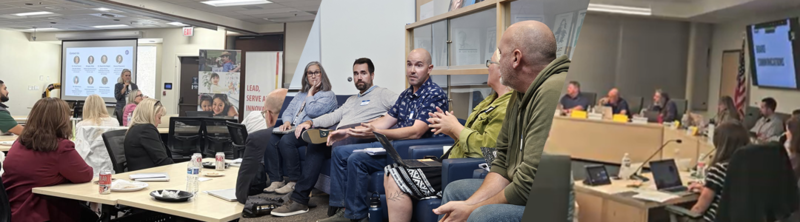
Dr. Spitzer and others are bringing that experience to statewide discussions, including OSBA’s fall meeting at Clackamas Education Service District. This provided another opportunity to address the same pressures. The Oregon School Board Association's (OSBA) Fall Regional Presentation outlined the gap between state funding assumptions and local compensation costs—and warns that redistributing school funding without adding resources cannot solve the underlying shortfall.
Every New Requirement Needs Resources Behind It
When we read about calculations for funding per student or annual budget totals, it does not show how much remains available to sustain classroom staffing and programs after the district meets other required expenses. When the state adds obligations without sufficient funding, schools must cover those costs from existing resources.
OCSD’s experience is helping make that issue visible beyond our community. In its October 13 reporting, OPB cited “unfunded mandates” identified in the district’s budget. Additionally, last year’s final cost of unemployment for 10-month employees was over $400,000 compared to about $30,000 in 2022-23.
The message is not that these obligations lack value. It is that the state must fund and sustain the commitments it requires districts to fulfill, rather than leave schools to absorb the cost.
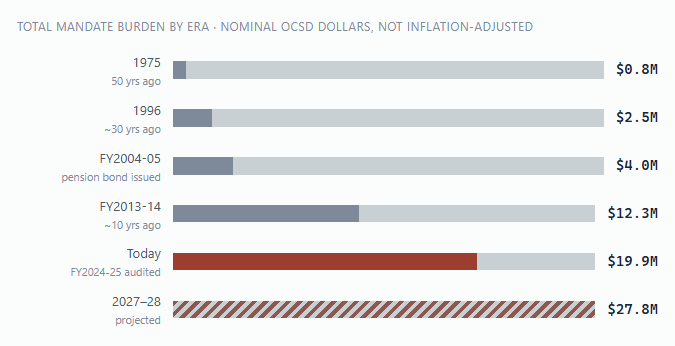
The issue is growing, in real time. This graphic showcases the growing obligation of costs from state mandates over the past 50 years. If you graduated in 1975 the school district only needed to reallocate $0.8 million dollars to cover state mandated requirements. Now, in 2026, the district needs to reallocate $19.9 million dollars of its budget prior to the start of this academic year’s budgetary needs.
Confronting the Scale of the Challenge - No Easy Solutions
The question isn’t whether these commitments matter. Funding PERS (public employee retirement systems) retirement benefits, providing special education services, and meeting other essential obligations are critical to educating all students and honoring promises made to educators. The challenge is how to pay for them. School districts must meet existing, growing, and new state requirements without sufficient state funding increases or access to additional funding mechanisms available to police and fire departments that can often increase fees, change taxation rates, and maneuver to add additional funding in ways school districts cannot.
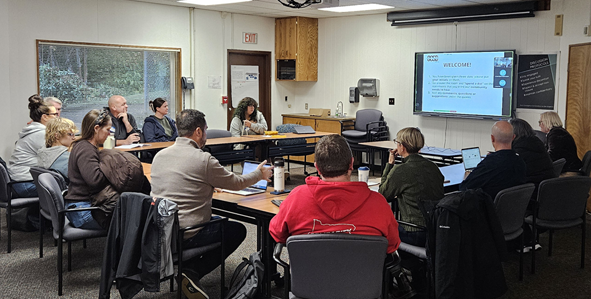
What can we do? Here at home, OCSD is also building understanding through the new Fiscal Learning Collaborative. Designed to bring together employee representatives, School Board and budget committee members, community members, students and district leaders. The collaborative connects state-level school district finance basics with real-time OCSD budget information. The FLC’s first meeting in September explored where district revenue comes from.
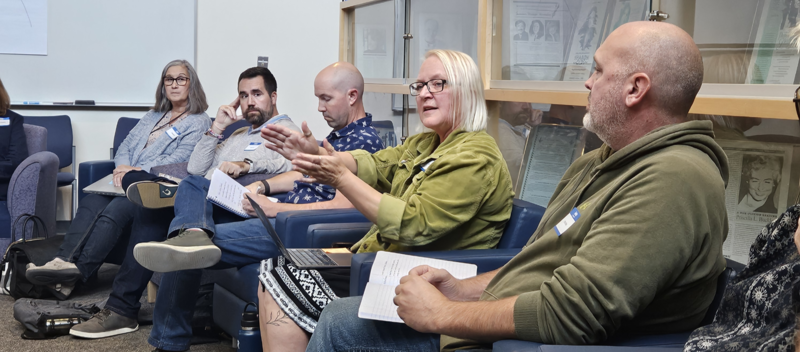
This creates a place to ask questions, understand tradeoffs and help shape informed communications and advocacy, not just hear about finances when reductions become necessary. This group will continue for multiple sessions, each meeting will focus on one topic at a time, to dive into the complex funding landscape OCSD and all 197 districts in the state must navigate. They will help guide communications to our broader community about funding information this year.
A Shared Vision Must Guide What Oregon Funds
Regionally, we’ve been collecting our voice to note larger state-level funding challenges. The bottom line: Oregon does not have a clear, shared vision for high-quality K–12 education across the state. Without agreement on what success looks like, how can the state determine what it takes to fund it?
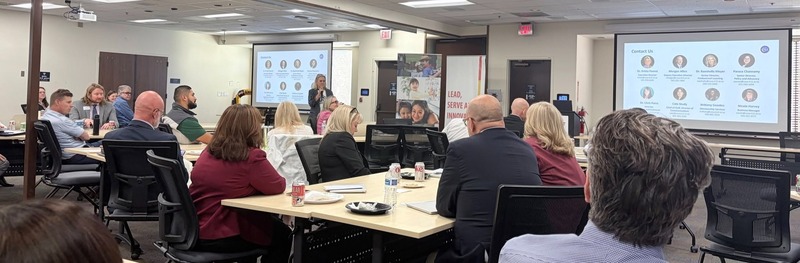
OSCD continues to be plugged into aspects of the five working groups operated by the Coalition of Oregon School Administrators (COSA). These groups are: instructional time, online and virtual learning, attendance, accountability and K–12 funding. In prior connections and at their fall session, Dr. Spitzer contributed perspectives on educational excellence, instructional time, virtual and home-based learning options, and school funding, to bring OSCD priorities to the State level discussion.
Students deserve more than a funding formula that no longer reflects reality. That is the work OCSD’s Superintendent, Cabinet and School Board are pursuing across multiple settings. We are bringing local realities to state leaders, building shared understanding at home and pressing for a system that supports our people rather than repeatedly asking them to do more with less.
The immediate work ahead centers on the 2027 legislative session, when lawmakers will set Oregon’s next two-year state budget and consider more than 3,000 bills. The November 18 revenue forecast will help frame the funding debate before the session begins January 19. Oregon School Board Association’s K–12 Advocacy Day on March 18 will provide an opportunity to bring school communities’ needs directly to legislators before the session concludes at the end of June. Throughout that process, OCSD’s Superintendent, Cabinet and School Board will continue pressing for funding that reflects actual costs, resources to sustain state requirements and a shared vision for student success. As this work continues, we will remain committed to open, ongoing communication with the people who make our schools strong.